Offset Bend Guide: Conduit Bending Formulas & Charts
What Is an Offset Bend?
An offset bend is two equal bends in opposite directions that moves the conduit parallel to its original direction. It's used to navigate around obstacles, transition between wall and ceiling, or align conduit with equipment knockouts.
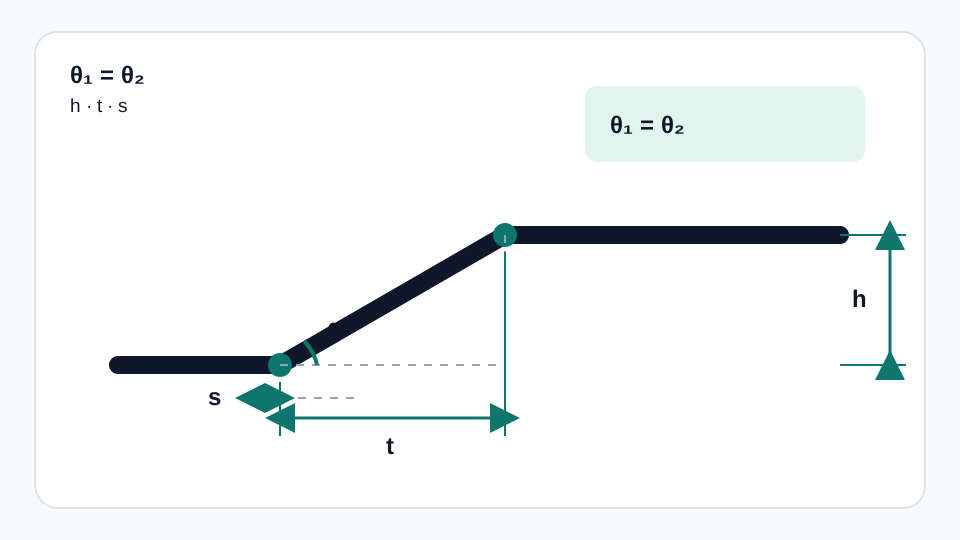
Offset Bend Formula
Travel = Offset Depth × Multiplier
Shrink = Offset Depth × Shrink Factor
Where:
- Offset Depth: The perpendicular distance to shift the conduit
- Multiplier: 1 / sin(bend angle)
- Travel: The distance along the conduit between the two bend marks
- Shrink: How much the conduit's end position shortens due to the bends
Multiplier and Shrink Table
| Bend Angle | Multiplier | Shrink per Inch | Common Use |
|---|---|---|---|
| 10° | 6.0 | 1/16" | Very shallow offsets |
| 22.5° | 2.6 | 3/32" | Gentle offsets |
| 30° | 2.0 | 3/16" | Most common offset angle |
| 45° | 1.414 | 1/4" | Standard offset |
| 60° | 1.155 | 3/8" | Steep offset (limited space) |
Worked Example
Scenario: Offset a ½" EMT conduit 4" to clear a beam, using 30° bends.
Step 1: Travel = 4" × 2.0 = 8" between bend marks
Step 2: Shrink = 4" × 3/16" = 3/4"
Step 3: Mark the first bend point on the conduit
Step 4: Measure 8" from the first mark for the second bend
Step 5: Add 3/4" to the overall conduit length to compensate for shrink
Step 6: Bend both marks at 30° in opposite directions
NEC Conduit Bending Limits
| Rule | NEC Section | Requirement |
|---|---|---|
| Max bends between pull points | 358.26, 344.26 | 360° total (equivalent of 4 × 90°) |
| Min bending radius | Chapter 9, Table 2 | Varies by conduit type and size |
| EMT ½" min radius | Table 2 | 4" |
| EMT 1" min radius | Table 2 | 6" |
| EMT 2" min radius | Table 2 | 8" |
Common Bending Mistakes
- Forgetting shrink: The conduit gets shorter after bending. If you don't compensate, the conduit won't reach the destination.
- Not matching bend angles: Both bends must be the same angle. Mismatched angles create a dog-leg, not a parallel offset.
- Exceeding 360° total: NEC limits total bends between pull points to 360°. Plan conduit runs to include enough pull boxes.
- Incorrect multiplier: Using 2.0 for 45° bends (should be 1.414) or 1.414 for 30° bends (should be 2.0). Always verify your angle.
Standards Reference
- NEC 358.26 — EMT Bends
- NEC 344.26 — RMC Bends
- NEC Chapter 9, Table 2 — Conduit Bending Radius
- NEC 358.24 — EMT弯曲半径
Frequently Asked Questions
What is the multiplier for a 30-degree offset?
The multiplier for a 30° offset is 2.0. Multiply the offset depth by 2.0 to get the travel distance between bend marks. Example: a 5" offset requires 5 × 2.0 = 10" between bends. Shrink is 3/16" per inch of offset.
How do you calculate an offset bend?
Measure the offset depth (perpendicular distance). Multiply by the multiplier for your bend angle (2.0 for 30°, 1.414 for 45°). Mark the conduit at that distance apart. Bend both marks at the same angle in opposite directions. Add shrink compensation to the overall length.
What is shrink in conduit bending?
Shrink is the apparent shortening of the conduit after making an offset. The two bends pull the end of the conduit closer. At 30°, shrink is 3/16" per inch of offset. At 45°, it's 1/4" per inch. Always add shrink to the conduit length before cutting.
How many bends can I have in a conduit run?
NEC allows a maximum of 360° of bends between pull points (junction boxes, conduit bodies, panels). That's equivalent to four 90° bends. This includes all bends — offsets, kicks, and saddle bends — not just 90° turns.
What angle should I use for offset bends?
30° is the most common and recommended angle. It has an easy multiplier (2.0), manageable shrink (3/16"/in), and creates a smooth pull path. 45° is used when space is limited. 60° should be avoided when possible — it's hard to pull wire through.