Box Fill Guide: NEC 314.16 Electrical Box Sizing
NEC 314.16 Box Fill Rules
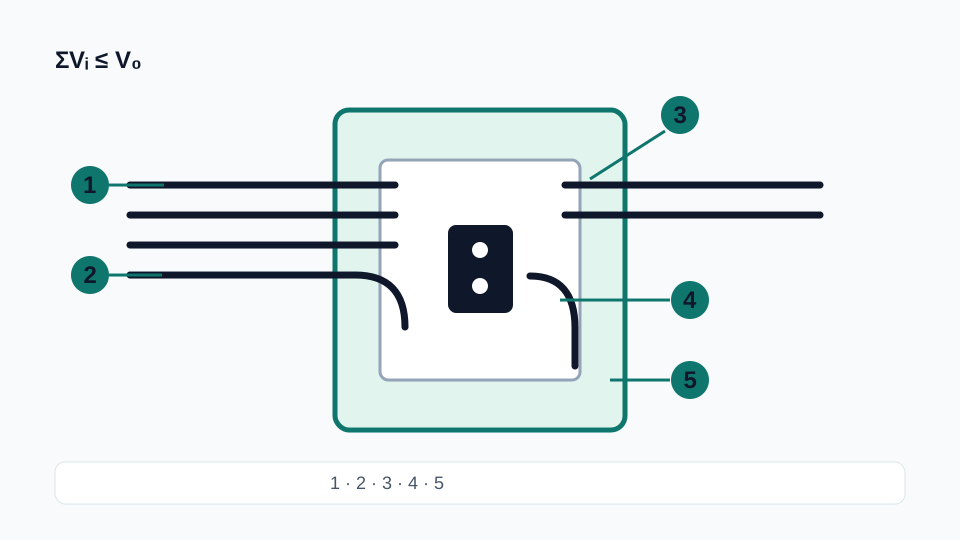
Every conductor, device, clamp, and support fitting in a box counts toward the fill limit. The total volume of all conductors must not exceed the box volume.
Conductor Volume Allowances
| Wire Gauge | Volume per Conductor | Max in 18 cu in Box | Max in 20.3 cu in Box |
|---|---|---|---|
| 18 AWG | 1.50 cu in | 12 | 13 |
| 16 AWG | 1.75 cu in | 10 | 11 |
| 14 AWG | 2.00 cu in | 9 | 10 |
| 12 AWG | 2.25 cu in | 8 | 9 |
| 10 AWG | 2.50 cu in | 7 | 8 |
| 8 AWG | 3.00 cu in | 6 | 6 |
| 6 AWG | 5.00 cu in | 3 | 4 |
What Counts as a Conductor
| Item | Count | Rule |
|---|---|---|
| Current-carrying conductor (hot, neutral) | 1 each | NEC 314.16(B)(1) |
| Ground wires (all combined) | 1 total | Count as 1 of the largest ground wire |
| Internal cable clamps | 1 total | Count as 1 of the largest conductor |
| Support fittings (yokes, ears) | 2 each | Count as 2 of the largest conductor on the device |
| Wire nuts / splices | 0 | Don't count (they're already counted as conductors) |
| Pigtail wires | 0 | Don't count (entirely within the box) |
Standard Box Sizes
| Box Type | Volume | 14 AWG Max | 12 AWG Max |
|---|---|---|---|
| Single-gang (3×2×1.5") | 18.0 cu in | 9 | 8 |
| Single-gang (3×2×2.125") | 20.3 cu in | 10 | 9 |
| Single-gang deep (3×2×2.5") | 25.5 cu in | 12 | 11 |
| Double-gang (4×2×1.5") | 34.5 cu in | 17 | 15 |
| Double-gang (4×2×2.125") | 42.0 cu in | 21 | 18 |
| 4" round (1.5" deep) | 21.0 cu in | 10 | 9 |
| 4" round (2.125" deep) | 30.3 cu in | 15 | 13 |
| 4-11/16" square (1.5" deep) | 42.0 cu in | 21 | 18 |
Worked Example
Scenario: Single-gang box (18 cu in) with 2 × 14/2 NM cables, one duplex receptacle.
Count:
- Hot conductors: 2 (one per cable)
- Neutral conductors: 2 (one per cable)
- Ground wires: 1 (all grounds count as 1)
- Cable clamps: 1 (internal clamps count as 1)
- Receptacle yoke: 2 (device counts as 2 of largest conductor)
Total: 2 + 2 + 1 + 1 + 2 = 8 × 2.0 cu in = 16.0 cu in
Box volume: 18.0 cu in → 16.0 ≤ 18.0 ✅ PASSES
Common Mistakes
- Forgetting the device (receptacle/switch): Each device counts as 2 of the largest conductor attached to it.
- Not counting grounds: ALL ground wires count as 1 conductor of the largest ground wire size.
- Using standard boxes for multi-cable entries: A standard single-gang box fills up fast with 3+ cables. Use deep boxes.
Standards Reference
- NEC 314.16 — Number of Conductors in Outlet, Device, and Junction Boxes
- NEC 314.16(A) — Box Volume Calculation
- NEC 314.16(B) — Conductor Volume
- NEC Table 314.16(A) — Metal Box Volume
Frequently Asked Questions
How do you calculate box fill?
Count each current-carrying conductor as 1, all grounds combined as 1, internal clamps as 1, and each device (receptacle/switch) as 2. Multiply the count by the volume allowance for your wire gauge (NEC 314.16(B)). Total must be ≤ box volume.
How many 12 AWG wires in a single-gang box?
A standard single-gang box (18 cu in) holds a maximum of 8 × 12 AWG conductors at 2.25 cu in each. A deep single-gang (20.3 cu in) holds 9. This counts all hot, neutral, ground, clamp, and device conductors — not just the wires you see.
Do pigtails count in box fill?
No. Pigtail wires that start and end within the box don't count toward fill. They're already accounted for in the conductor count. Only wires that enter or leave the box (through cables) count.
What is a standard electrical box size?
Standard single-gang boxes are 3×2 inches with depths of 1.5" (18 cu in), 2.125" (20.3 cu in), or 2.5" (25.5 cu in). Always check the box volume stamp — not all boxes of the same shape have the same volume.
Can I use a deeper box instead of a larger box?
Yes. If the standard box doesn't have enough volume, use a deeper box of the same shape. A deep single-gang (2.5" deep, 25.5 cu in) may have enough room for your fill without changing to a double-gang box.